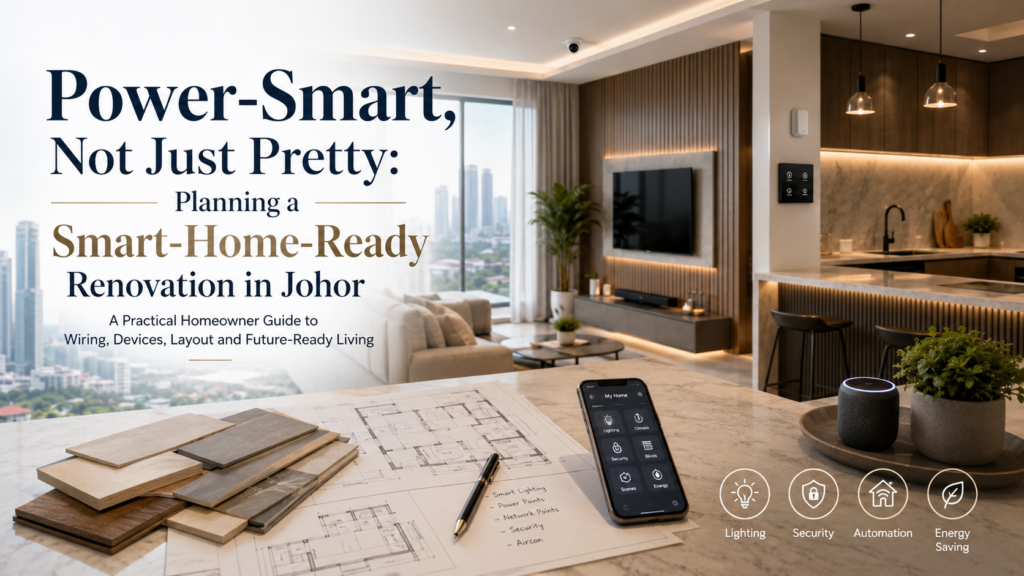

A few kilometres from your house, in palm-fringed parks at Sedenak and Iskandar Puteri, some of Southeast Asia’s biggest data centres are humming away. Johor is quietly becoming the region’s digital backbone. So here’s a fair question to ask before your next renovation: if the whole state is being wired for the future, why is your home still being planned around how it looks rather than how it connects?
Most renovations in JB still chase the same two things — nice finishes and more storage. Both matter. But there’s a third layer almost everyone forgets until it’s too late: making the home power-smart. Not a gimmick-filled “smart house” with talking fridges nobody uses — just a home that’s genuinely ready for connected living, with the network, cabling and power planned properly before the walls close.
This is the part you can’t easily fix later. Once the tiles are laid and the cabinets are installed, adding hidden wiring means hacking finished surfaces or living with ugly trunking. Plan it early and it disappears into the design. Here’s how to do it right — and why custom-fit cabinets are the quiet layer that ties it all together.
Johor is becoming a data-centre state — your home should keep up
This isn’t hype. Johor has become one of Southeast Asia’s fastest-growing data-centre markets, on track to reach roughly a 1-gigawatt market by the end of 2026 and projected to hold a large share of Malaysia’s total data-centre capacity by 2030. Much of it is spillover from Singapore — when the city-state paused new data-centre approvals, the hyperscalers crossed the Causeway into Johor, a strategy the industry calls “Singapore Plus.” You can read the lay of the land in The Edge Singapore’s coverage of the boom.
Add the Johor–Singapore Special Economic Zone and the RTS Link arriving around end-2026, and you get a clear picture: more digital infrastructure, more cross-border professionals, more connected lifestyles. The homes being renovated in JB today will be lived in through all of that. A house planned to be 智能家居 (zhì néng jiā jū, a smart home) ready — not necessarily fully automated on day one, just prepared — is simply a home that ages well in a state that’s going digital fast.
The question is moving from “is my house nice?” to “is my house ready?” Power-smart planning is how a renovation done in 2026 still feels current in 2031.
What “power-smart” really means (and what it doesn’t)
Let’s be straight about this upfront, because plenty of people overpromise. Going power-smart will not magically slash your electricity bill, and you should raise an eyebrow at anyone who guarantees you a fixed “save 30%”. Your bill depends on how you actually use your home — that’s it.
What a power-smart home genuinely gives you is three real things: convenience (control lights, switches and cameras from your phone, set scenes, automate routines), control (know what’s happening at home from anywhere — useful for families with elderly parents or kids), and a clean, future-proof installation (no serabut tangle of cables, no surface trunking, no “aiya should’ve planned earlier”). That’s the honest pitch. Readiness, not magic.
- Readiness — points and pathways in place so you can add devices anytime without breaking walls.
- Convenience — switches, lighting and cameras that respond to your phone or a tap.
- Control — visibility and access to your home wherever you are.
- Clean installation — every cable concealed, every device with a proper home.
Start with the backbone: router and mesh Wi-Fi placement
Everything smart rides on one thing — a strong, even network. And the single most common mistake in JB homes? Stuffing the router inside a closed cabinet near the front door (wherever the Unifi point happens to land), then wondering why the bedroom upstairs has one sad bar of signal.
Plan it properly and the fix is easy. The main router wants a central, ventilated home with cable access — designed into the cabinetry, not jammed into a shoe drawer where the signal gets smothered. For double-storey landed homes and bigger units, you also pre-wire points for mesh Wi-Fi nodes — typically one upstairs and one at the far end of the house — so coverage is even everywhere, including the dapur and the yard. Done at the design stage, these niches look intentional and stay kemas (tidy); done later, they’re an afterthought taped to a wall.
One ventilated router niche · 1–2 mesh node points · network cabling run inside walls and cabinets. Decide these before tiling and you’ll never see a cable again.
Hidden cabling and smart switches: decide before the wall closes
This is the heart of being power-smart, and it’s almost entirely a timing decision. While walls are hacked open and cabinets are still on the drawing board, running concealed 布线 (bù xiàn, cabling) — network, speaker, camera, conduit for future use — costs little and vanishes completely. After renovation? You’re drilling finished walls or living with plastic trunking running along the skirting. Senang choice, really.
The same logic applies to smart switches. Most smart switches need a neutral wire at the switch box — a small detail that’s trivial to plan now and a real headache to retrofit later. So decide early where you want smart lighting, then make sure the wiring supports it. While you’re at it, plan your plug points like an adult who owns devices: enough sockets at the study desk, bedside USB points, extra points behind the TV and along the kitchen counter where the air-fryer, kettle and coffee machine all fight for space. People always underestimate how many plugs they need — until they’re living with a daisy-chain of extension cords.
Here’s where the work has to be coordinated, not left to chance. A renovation involves a carpenter, an electrician, a tiler — and if nobody’s holding the master plan, the power points end up in the wrong place relative to the cabinets. This is exactly the gap AmpQuartz is built to close: one team orchestrating the cabinet design around the electrical and network plan, so the points land where the devices will actually live. One accountability line, not three contractors pointing fingers.
Device zones: TV console, kitchen and where the power goes
Smart homes generate clusters of gear, and clusters need a home. Two zones do the heavy lifting.
The TV console as a device zone
Your TV console is no longer just for the TV. It’s mission control: router or mesh node, Android/Astro box, game console, soundbar, a smart hub, maybe a Tapo base. Designed as a proper device zone, a custom console gives each item a ventilated slot, hidden cable grommets, a concealed power strip and routing up to the wall-mounted screen — so the whole wall looks clean instead of a nest of black boxes and dangling wires. This is the difference between a console you bought and one designed for how you actually live.
Kitchen appliance power planning
The modern dapur is the most power-hungry room in the house — oven, hob, hood, fridge, microwave, instant water heater, dishwasher, and a countertop army of small appliances. Plan these dedicated points during the cabinet design, not after, so each appliance has its own correctly rated socket exactly where it sits, with no extension cords snaking across wet counters. This is core to a good wet-and-dry kitchen layout and proper appliance integration. Our handmade custom kitchen cabinets start from around RM330 per foot run for solid plywood and from RM450 per foot run for fully custom aluminium with ACP — and because they’re built to your exact layout, the power planning is baked in rather than bolted on. For the full cost breakdown, see our kitchen cabinet price guide.
Cameras and sensors: planning Tapo placement properly
Home security gear like Tapo cameras, door/window sensors and motion detectors are cheap and easy to buy — and easy to install badly, dangling off a wall with a visible wire running to the nearest plug. Plan their placement during renovation and they integrate cleanly: pre-wired points at the porch, entrance and key corners; cabinet-integrated mounting where it makes sense; concealed routing back to power and network.
For families, the value is real and has nothing to do with bills — it’s peace of mind. Check the front gate from the office, see that the kids got home safe, keep an eye on elderly parents in the next room. The hardware is yours to choose; our job is to make sure the home is ready for it, so adding a camera later is a five-minute job, not a renovation.
Why custom cabinets are the integration layer
Step back and you’ll notice something: every one of these decisions — the router niche, the hidden cabling, the device zone, the appliance points — converges at the cabinetry. The cabinets are where power, network and devices physically meet. That’s why they’re the natural integration layer of a power-smart home, and why this is so hard to do with off-the-shelf modular units that don’t line up with your specific wiring plan. Custom-fit is what lets the plan and the build speak to each other.
It’s also why orchestration matters more than any single product. The reason AmpQuartz exists is to coordinate the whole thing under one roof — filtered, accountable craftsmen building cabinets designed around your power and network plan, then backed by genuine lifetime support, so the same team that planned your device zones can adjust them years down the line. You can see the coverage on our warranties page. A connected home only stays good if someone’s still answerable for it in 2031 — and we plan to be.
That long-game thinking shows up off the worksite too. Beyond cabinets, we’re rooted in the Johor community — backing local badminton and the growing pickleball scene through the AmpQuartz Badminton Club. A business that shows up consistently for its community is one that’ll still pick up the phone when you want to add a sensor or re-route a cable. Have a look at the community & events page. And if you’d like to spread the cost of a proper whole-home job, our financing options include a 24-month 0% plan — readiness shouldn’t have to wait.
For Singapore owners renovating a Johor property — and there are more every month as JS-SEZ and the data-centre economy pull people across — this matters double. A smart-home-ready home is easier to manage remotely, and a local JB team that handles design, build, install and after-sales gives you one point of contact instead of a cross-border headache.
Smart-home-ready renovation FAQ
What does a smart-home-ready renovation actually mean?
It means planning your home’s network, power points and device locations before the walls and cabinets are built, so smart devices can be added neatly later — a proper home for your router and mesh Wi-Fi, hidden cabling, smart switches with neutral wiring, enough plug points in the right places, and tidy device zones in the TV console and kitchen. It’s about convenience, control and clean installation, not a promise to lower your electricity bill.
Do I need to plan smart-home wiring before renovating, or can I add it later?
Before is far better. Hidden cabling, conduit, extra plug points and neutral wiring for smart switches are easy and cheap to add while walls are open and cabinets are being designed. Doing it after renovation usually means surface trunking, drilling finished walls or visible cables — messier and more expensive.
Where should the router and mesh Wi-Fi go in a Johor home?
Central and elevated, not buried inside a closed shoe cabinet or behind the TV where the signal gets blocked. In a double-storey home, plan a ventilated cabinet niche with cable access for the main router, and pre-wire points for mesh nodes upstairs and at the far ends of the house for even coverage.
Can custom cabinets hide cabling and smart-home devices?
Yes — that’s exactly where custom-fit cabinetry earns its place. A custom TV console can house the router, media boxes, a hub and a power strip with ventilation and cable grommets, while kitchen and wardrobe cabinets can conceal wiring runs and dedicated device points. Modular off-the-shelf units rarely line up with your power and network plan.
Will a smart home lower my electricity bill?
We don’t make savings claims, and you should be cautious of anyone who promises a fixed percentage off your bill. The honest value of a smart-home-ready home is convenience, control and a clean, future-proof installation. Any energy effect depends entirely on your own usage habits.
How much does smart-home-ready cabinetry cost in Johor?
Smart-home readiness is mostly a planning decision rather than a big separate cost — it’s about routing cabling, niches and power points correctly during design. AmpQuartz custom cabinets start from around RM330 per foot run for solid plywood and from RM450 per foot run for fully custom aluminium with ACP doors, with the integration planning built into the design process. Request a quote for a figure based on your home and device list.
Plan a home that’s ready for what’s next
Tell us your home and the devices you use (or plan to). We’ll design cabinetry around your power and network plan — router niches, hidden cabling, device zones — so your renovation is power-smart from day one, with nothing left dangling.
Get your quote → Or size up your renovation first with the JB renovation cost index.This article is about planning and installation readiness only. AmpQuartz does not make electricity-saving or bill-reduction claims; any energy outcome depends on your own usage. Smart devices (routers, cameras, switches, sensors) are chosen and supplied by the homeowner — our role is to design cabinetry and coordinate the power and network plan so the home is ready for them. Prices are indicative starting points and vary with scope and materials. Data-centre and RTS Link figures are based on public reporting current at time of writing.