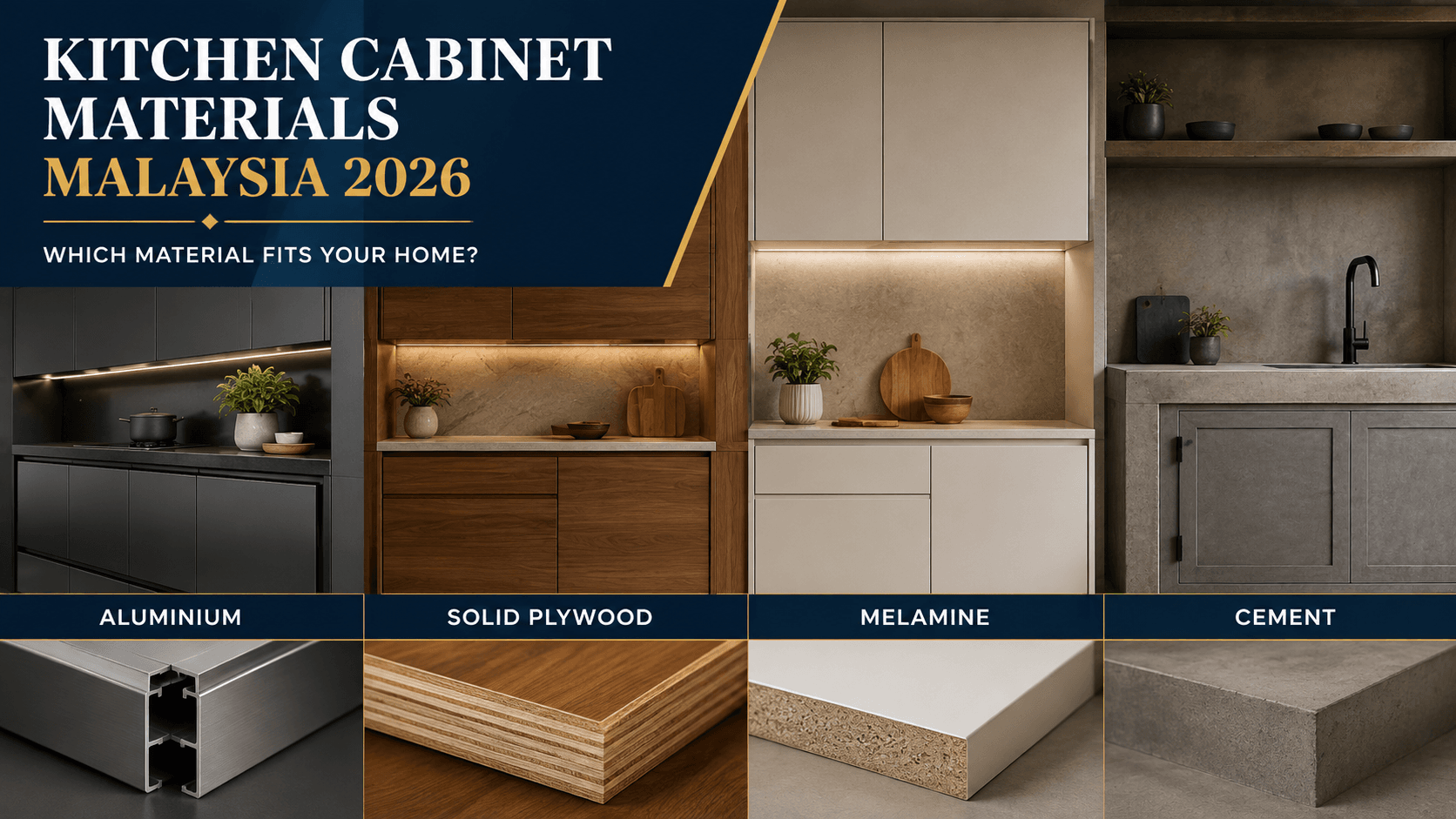

Kitchen Cabinet Materials Malaysia 2026: Aluminium vs Solid Plywood vs Melamine vs Cement
Real 2026 prices per foot, how each material survives Malaysian humidity and termites, and the honest verdict for your type of home.
The short answer: for most Malaysian kitchens in 2026, handmade solid plywood (from around RM330 per foot run) is the best value all-rounder — and yes, it works in wet kitchens too, because its laminate surface is water-resistant as long as the cabinet is never left soaking. Fully custom aluminium (from around RM450 per foot run) is the upgrade when termites, coastal damp or zero-maintenance matter, because metal is simply immune. Melamine particle board (market guides quote RM180–280 per foot) is the budget entry with the shortest lifespan once water reaches its core, and site-built cement is the nostalgic heavyweight that modern hinges struggle to love. The rest of this guide is the evidence — so you can choose on value, not just price.
Here’s the thing nobody tells you at the showroom: Malaysia is one of the hardest countries on Earth to own a kitchen cabinet. Relative humidity sits around 80% most of the year (MET Malaysia data rarely shows it dipping far below 70%), which means every cabinet in every Johor home is living in a slow-motion steam room. Choosing a cabinet material here is like choosing tyres for Malaysian roads — what works fine in a dry European brochure behaves very differently after two monsoon seasons and one leaking sink joint.
Which Kitchen Cabinet Material Is Best in Malaysia? The Full Comparison
| Material | 2026 price/ft run | Humidity | Termites | Realistic lifespan | Best for |
|---|---|---|---|---|---|
| Fully custom aluminium + ACP | from RM450 (6G honeycomb RM650–700) | Immune | Immune | 20–30 years | Wet kitchens with termite history, coastal homes, zero-maintenance households |
| Solid plywood (handmade, laminated) | from RM330 | Water-resistant laminate — fine wet or dry if never soaked | The one real risk — resistant, not immune | 15–25 years | Wet AND dry kitchens on best value-per-ringgit, warm interiors |
| Melamine / E0 particle board | RM180–280 (market guides) | Weak — swells once moisture enters | Vulnerable | 5–10 years | Rentals, dry kitchens on tight budgets |
| MDF (painted/spray) | RM200–300 (market guides) | Weak at cut edges | Moderate | 7–12 years | Smooth painted looks away from water |
| Solid wood (rubberwood/oak) | RM350–450 (market guides) | Moves with moisture | Attractive to termites untreated | 15–25 years with care | Traditional and luxury styling |
| Cement / concrete (site-built) | mason-dependent, quote-by-quote | Excellent | Immune | 30+ years (structure) | Kampung-style permanence; hybrid bases |
One number that reframes the whole table: a RM200/ft melamine kitchen replaced twice in 20 years costs more than a RM450/ft aluminium kitchen installed once — before counting the two renovations’ worth of hassle.
Are Melamine Kitchen Cabinets Good Enough for Malaysian Homes?
Honestly — sometimes, yes. Melamine cabinets are a melamine-resin skin over particle board, and 2026 market guides price them around RM180–280 per foot — the cheapest proper cabinet you can buy. For a rental unit, a first home you plan to upgrade later, or a dry kitchen that never sees a wok, E0-grade melamine does the job and looks clean doing it.
The catch is what happens when water finds the core. Particle board drinks moisture like a Milo dinosaur drinks condensed milk — one leaking sink joint, one steamy month, and the board swells, the skin lifts at the kettle corner, and the doors stop closing flush. That’s why the honest comparison in our plywood vs melamine guide ends the same way for most Johor households: melamine for the dry zone if budget is tight, something stronger where the cooking happens.
Is Solid Plywood Worth the Extra Money — and Can It Go in the Wet Kitchen?
Yes, and yes. Plywood is cross-laminated real wood, which is why it holds screws (and therefore hinges) dramatically better than particle board, and why a handmade solid plywood cabinet at RM330 per foot run outlives two melamine kitchens.
Here’s the myth worth killing: “plywood cannot go in the wet kitchen.” Not true. The laminate skin on a properly built solid plywood cabinet is water-resistant — daily splashes, steam and wipe-downs are exactly what it’s made for. The only rules: don’t let cabinets sit soaking (fix leaks fast, don’t let water pool in the sink cabinet), and make sure the edges are properly sealed — which is where handmade construction beats factory-rushed. Do that, and solid plywood is the cheaper wet-kitchen choice at RM330 versus aluminium’s RM450. The one genuine risk left is termites: plywood is resistant but not immune, so if your taman has termite history, that’s the moment aluminium earns its premium.
Plywood’s other superpower is the thing no laminate can fake: grain. Warm, natural, ages-gracefully grain — the same reason design media spent last year praising unpainted wood kitchens. If your kitchen is part of your living space, plywood makes it feel like furniture instead of equipment.
When Is Aluminium Worth the Premium Over Plywood?
When you want immunity instead of resistance. Aluminium cabinets don’t play the humidity-and-termite game at all: metal doesn’t drink water, and termites can’t eat it — not “resistant”, immune. Powder-coated aluminium with ACP panels starts around RM450 per foot run, and the flagship 6G honeycomb series (RM650–700 per foot) adds a honeycomb core that keeps large doors light, rigid and warp-free for decades. Choose it over plywood when: your area has termite history, you’re near the coast, the household cooks hard twice a day with nobody free to baby the cabinets, or you simply never want to think about this again for 25 years.
The honest cons — covered fully in our aluminium pros and cons breakdown: doors can be noisier than wood without soft-close hardware, the metal feel isn’t for everyone, and cheap 3G builds from budget contractors give the material a bad name. And if you’re weighing it against the budget option directly, the aluminium vs melamine comparison shows where each ringgit actually goes. One more 2026 reality: global aluminium prices move with world events, which is why two quotes a month apart can differ — lock pricing when your quote is issued.
Should Anyone Still Build Cement Kitchen Cabinets?
The kampung classic deserves respect: a site-built cement cabinet is effectively part of the house. It shrugs off water, termites ignore it, and it will outlive everyone reading this page. But the reasons it faded are real — no soft-close drawers, tiled surfaces with grout lines that stain, cracking over time, zero flexibility (changing the layout means demolition), and quality that depends entirely on your mason, so prices swing quote by quote.
Where cement still makes sense in 2026: the hybrid build. A cement base structure for outdoor kitchens or heavy-duty wet zones, fitted with aluminium doors and drawers on top — old-school mass, modern hardware. We build these more often than people expect for outdoor kitchens in Johor.
Which Cabinet Material Fits Your Home?
The Material Is Half the Decision. The Other Half Is Who Coordinates Everything
Here’s the part of the renovation journey nobody prices into their comparison: a kitchen cabinet never arrives alone. Behind every install there’s an electrician moving points for the hood and oven, a plumber shifting the sink and tap, the countertop team templating and fitting, hardware and accessories arriving on schedule. All of them are human, all of them share one jobsite — and one problem in one trade cascades into everyone else’s delay.
This is why the most expensive mistake in Johor renovations isn’t picking the wrong board — it’s homeowners hiring their own electrician and plumber based on the cheapest price. A wrongly-positioned power point behind a cabinet, a drain that doesn’t line up with the sink cabinet, a tiler who shows up two weeks late: each one costs more to fix than the “savings”, and the finger-pointing between trades becomes your full-time job. A proper cabinet maker brings experienced electricians and plumbers as part of one coordinated team — one schedule, one accountability, one phone number when something needs adjusting.
That’s the real meaning of one-stop cabinetry: cabinets, electrical works, sink and tap, accessories and hardware, tabletops, plumbing services, even financing solutions — planned together so your renovation is peace of mind, not project management. And a small request from every jobsite veteran to every homeowner: be considerate with scheduling, allow time for readjustments, and once the design is confirmed, don’t keep changing it — every mid-project change ripples through five other people’s work. A happy, well-communicated renovation is where good feng shui actually comes from.
One more thing worth knowing when comparing cabinet specialists: the fair comparison is value, not just the per-foot number. Standard-design cabinets should come at genuinely affordable, competitive prices with full quality, service and warranties — and when your designer draws something complex (curved islands, floating displays, feature walls other carpenters can’t build, won’t build, or have never built), the specialist’s workshop is what turns the drawing into furniture. That range — affordable standard to complex designer work, with free 3D design before any payment, a written quote naming the exact board grade, a 30-day delivery guarantee and 0% 24-month installments — is what a cabinet specialist looks like on paper. The full cost picture is in our 2026 Johor price guide.
Not sure which material your kitchen needs? Send your floor plan and cooking style on WhatsApp for an honest recommendation — or get a ballpark price in minutes with the instant quote tool.
💬 WhatsApp us your floor plan → ⚡ Get an instant quote →FAQ: Kitchen Cabinet Materials in Malaysia
What is the best material for kitchen cabinets in Malaysia?
Handmade solid plywood (from about RM330 per foot run in 2026) offers the best value for most Malaysian kitchens, including wet kitchens — its laminate surface is water-resistant as long as cabinets are never left soaking. Fully custom aluminium (from about RM450 per foot run) is the most durable choice where termites, coastal damp or zero-maintenance matter, being fully waterproof and termite-proof. Melamine suits tight budgets in dry zones.
Can solid plywood cabinets be used in a wet kitchen?
Yes. Properly laminated and edge-sealed solid plywood cabinets handle daily wet-kitchen splashes and steam well, because the laminate surface is water-resistant. Avoid letting water pool or soak the cabinet, and fix leaks quickly. The main remaining risk is termites — in termite-prone areas, aluminium is the safer upgrade.
Should I hire my own electrician and plumber for a kitchen renovation?
It usually costs more in the end. Kitchen cabinet installation depends on correctly positioned wiring, points and plumbing; separately-hired trades chosen on price often misalign with the cabinet plan, causing rework, delays and disputes. A one-stop cabinet specialist that coordinates experienced electricians, plumbers, countertop and hardware teams under one schedule delivers a smoother result and single accountability.
How much do kitchen cabinets cost per foot in Malaysia in 2026?
Typical 2026 ranges: melamine/E0 particle board RM180–280 per foot run, MDF RM200–300, handmade solid plywood from RM330, solid wood RM350–450, and fully custom aluminium with ACP panels from RM450 (premium 6G honeycomb aluminium RM650–700).
Which kitchen cabinet material is termite-proof?
Aluminium and cement are fully termite-proof. Treated plywood is resistant but not immune, while particle board, MDF and untreated solid wood are vulnerable to termite damage in Malaysian conditions.
Do melamine kitchen cabinets last in humid climates?
Melamine cabinets typically last 5–10 years in Malaysian humidity. The melamine surface itself resists moisture, but once water reaches the particle-board core through edges or joints, the board swells and the cabinet deteriorates quickly.
What are the disadvantages of aluminium kitchen cabinets?
Aluminium cabinets can be noisier than wood without soft-close hardware, feel colder or more industrial than natural grain, and cost more upfront (from about RM450 per foot run). Low-grade aluminium builds with thin frames can also rattle — build quality matters more than the material label.
Are cement kitchen cabinets still worth building?
Cement cabinets are extremely durable and termite-proof but lack modern hardware, crack over time, and cannot be reconfigured without demolition. In 2026 they make most sense as hybrid builds: a cement base structure fitted with aluminium doors, especially for outdoor kitchens.